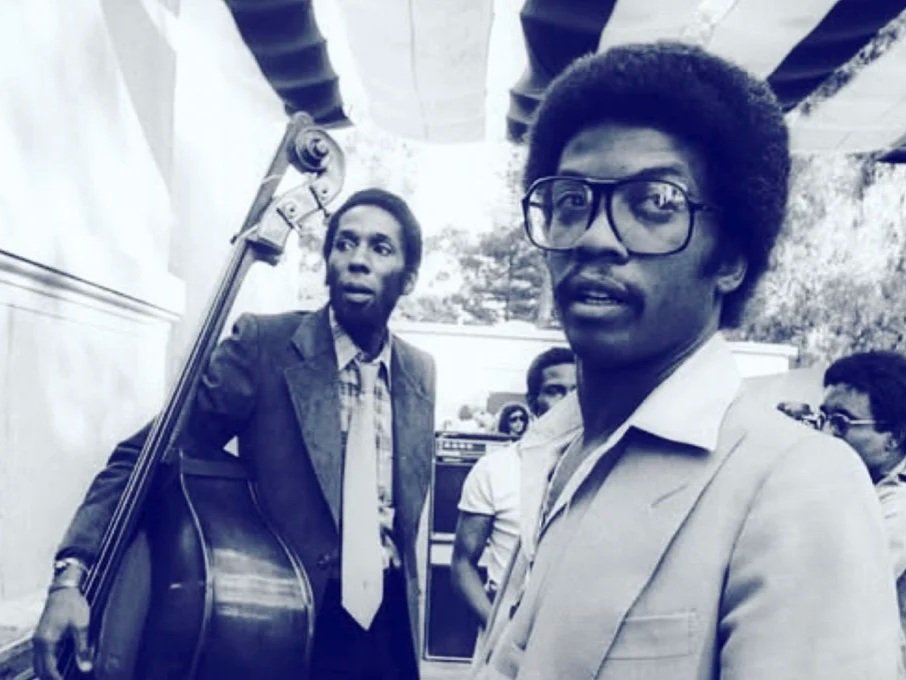
I was sitting behind the stage at the Monterey Jazz Festival where Ron Carter and Herbie Hancock were performing a set as a duo. And this was the first time they were doing so. Maestro Carter is 89 and Herbie is 86. The stage was big, the audience large, and the expectations were very high.
They are both masters, rather, architects of this music and in some ways they can do no wrong. If you are a trailblazer, the trails you decide to make would be the ways. We all have been following after the musical trails they laid out. Their musical lives are the history of modern jazz. They both explored the field and opened many trails for us. Now they are on stage at the Monterey Jazz Festival and it feels like they are back to where they started. Two remaining members of the Miles Davis Quintet paying homage to their late boss. I can’t even begin to imagine what that must feel like.
Our accomplishments and the trails you leave behind can sometimes be a ball and chain. It gets harder to do things that can potentially make you fall on your face as you age. It’s also hard to do things that you used to do really well but can’t do like when you were in your 20s. Imagine falling off of your bike. It’s nothing when you are 10 but doing that at 55 could be much more painful and embarrassing and yet you don’t want people to know that you are hurting. When you are nobody, you fall but since nobody was watching, according to quantum physics, you didn't really fall. It hurts less and you brush it off and you move on. But not when you are Maestro Ron Carter and the one and only Herbie Hancock; every key stroke and every pull are observed intently. Their performance will be recorded, analyzed, and repeatedly consumed.
I looked out into the audience at one point and I felt such a feeling of sonder: how their music has been the soundtrack to the lives of each audience member and how each of us has different memories and emotions attached to the music and we came to Monterey with so much history and remembrances and joy and pain and anticipation. In that open air stadium filled with so much adoration and expectations, Ron and Herbie were just steady and present.
It is a wondrous and beautiful thing to witness. Two masters who have been at it for several decades still know how to be in the moment and be vulnerable in front of thousands of people. They played with tenderness, care, and humor. It felt intimate and spacious. What a courageous thing to do and what a lesson that is for all of us. I wished to be so at peace and yet be searching and be vulnerable like them when I grow up.
At one point, Herbie played Maiden Voyage solo. He wrote the tune in 1965 when he was 25. 61 years later, he played the song which has been played by literally everyone who ever wanted to learn how to play this music since then and yet still his solo rendition filled the stadium with reverent silence. What an incredible thing to have created something that has been loved for decades in the genre that seems to morph so rapidly, so much so that I spend my days thinking about the question of “what is jazz?” This sounds so corny but I thought to myself, “wow. I’m witnessing something important and historical.”
Excellence, I think, is really important. It’s a baseline. But beyond that, it’s not the perfection that resonates nor the point. It’s how you show up with love. I don’t really know how to describe what I felt that night otherwise.
music
Photograph by Hiroko Masuike for the New York Times.
New York Times →
A little over a year ago, Stephanie Jones did a feature on me for the New York Times. My conversations with her went all over the place and combined that with the character limits, I know she had a difficult time making sense of my stories and fitting them all in. I think she did a great job and the article gives a good sense of what I do and how I carry myself in the world.
AT 30, THE JAZZ GALLERY REMAINS THE FORCE. RIO SAKAIRI IS AT ITS HEART.
The nonprofi t venue’s artistic director has long booked and guided artists from her gut.
By Stephanie Jones
February 17, 2025
Rio Sakairi patted around inside her purse and retrieved a key that unlocks theelevator at 1158 Broadway. Exiting on the fifth floor, she glanced toward the blackdoor leading to the performance space in Manhattan’s Flatiron neighborhood, where The Jazz Gallery has made its home since 2012. The saxophonist BenWendel’s four-vibraphone band was about to perform on this January night: “This one you want to hear from the beginning,” she said.
The Jazz Gallery has long had a reputation as a live music venue where artists take risks and stretch their sound. This year, the nonprofit is celebrating its 30thanniversary; Sakairi has served as its artistic director since 2000. (She received the formal title in 2009.)
“It’s really just the music that’s driving my decisions,” she said, settling her coat ona sofa in the Gallery’s board room. Sakairi, 53, has been programming the venuefor about as long as she’s been working there. “When people ask me what I play, Ijokingly say, ‘I play musicians.’”
Sakairi is credited with nurturing an environment that has given major artists an early boost, including Gretchen Parlato, Linda May Han Oh, Gerald Clayton, Lizz Wright, Vijay Iyer, Ambrose Akinmusire, Joel Ross, Miguel Zenón, Kris Davis and Robert Glasper. “Absolutely my first real show as a leader” was at the Gallery, Glasper said via email, adding that the venue “was always open to me exploring what was in my mind and working it out live in front of an audience.”
For as long as these artists can remember, Sakairi has been a fierce, albeit frank advocate of artistic expression and development.
“We have this saying — and I’m pretty sure she knows — ‘Keepin’ it Rio,’” the saxophonist and electronic wind instrumentalist Dayna Stephens said in a phone interview. “She doesn’t hold back.” While Sakairi’s feedback can be “very assertive and very straightforward,” he said, “there’s always advice for how to get to where you want to go.”
Founded in 1995 by the academic turned music presenter Dale Fitzgerald, the singer and WBGO on-air host Lezlie Harrison and the trumpet master Roy Hargrove, the Jazz Gallery began as a haven for creative improvisers and experimental composers, and provided a daily rehearsal space for Hargrove. (For several months, his label Verve picked up the rent.) Fitzgerald, who was Hargrove’s manager, located the original space on Hudson Street in SoHo, and the trio dreamed up a spot that could serve as an incubator for musicians and host art exhibitions related to jazz.
Sakairi grew up far from that original location — in Tsuchiura, Japan, where she began playing piano at age 4. Later, she joined her middle school’s string quartet, then served as her high school’s choir conductor. “I always had music in my life,” she said.
In Tsuchiura, her private K-12 school focused on independent thinking and problem-solving. One seventh-grade trip included a daylong hike to a campground. “They give you a map and divide you into groups of six, and then we have to get there on our own.”
Skilled in rhetoric, Sakairi used her father’s belief that people should “live for their dreams” to her advantage, convincing her “very strict, old-school” parents that she should earn a psychology degree in a foreign country. At 19, she immigrated to New York to attend the New School’s Eugene Lang College of Liberal Arts, and soon found her way to the university’s School of Jazz and Contemporary Music.
After graduation, Sakairi took a job at the skin-care store Kiehl’s, enrolled in a music business course at Baruch College and frequented music venues and art spaces across the city, listening and learning. “Music continued to be a big part of my life,” she said. In 2000, after she presented a fund-raiser at the Gallery, she heard that Fitzgerald was looking for assistance and seized the opportunity: “I’m thinking, Oh my God, this is my foot into the music business door!” she recalled. The job paid $50 per night, and she’d head straight to the venue from her day job.
Her duties included cleaning the restroom and paying the bands. But Sakairi quickly realized she had an ear for booking. On Sundays, she’d come into the building to listen to CD and cassette submissions. “A couple months into it, I said, ‘This guy Vijay Iyer, he sounds pretty good. We should give him a gig.’”
One evening in 2001, the saxophonist T.K. Blue called to ask whether the Gallery would host Randy Weston’s 75th birthday celebration. Fitzgerald reasoned the date was too soon and hung up. Sakairi didn’t hold back. “I said, ‘Dale! What are you doing?’” she remembered. “‘Pick up the phone and call him back — we are so doing Randy’s 75th birthday!’”
Before long, Fitzgerald handed the booking role over to his protégée entirely. Sakairi’s vision was clear: When “a young musician plays here, it means something.” Since then, she has fostered artistic breakthroughs by concentrating on development, acting as a kind of career consultant with an eye on artists’ onstage presence and even their promotional plans. “I try to make a point,” she said. “There’s no there. There is a process.”
When Sakairi reviews submissions, she leans on her gut: “People ask me all the time, ‘What do you listen for?’ It’s really a feeling,” she said. Stephens, who received the Gallery’s 2024 fellowship commission for mid-career artists, noted that Sakairi also has a pulse on professional development. “She has a very innate sense of what the next move for a particular artist is at their stage,” he said.
Sakairi’s petite stature belies her commanding presence. (“For a long time people either ignored or underestimated me,” she said.) As musicians orbit around her, she greets each of them with genuine warmth: a double-palmed handshake, a twinkling sigh, a hug. Over her years at the Gallery, she’s demonstrated poise under pressure. “There’s like five eviction notices in these documents,” she said, motioning to a file cabinet. During its tumultuous move from Hudson Street, the Gallery didn’t cancel a single booking. And when Covid hit, the venue rebounded with award-winning online programming.
“I rarely ever panic,” Sakairi said. “I just say, ‘Eh, it’ll be all right.’”
The Gallery’s deputy director, Nerissa Campbell, has seen Sakairi navigate these hard times. “Rio’s philosophy, which I think has become an ethos of sorts for The Jazz Gallery, is that ‘there are no jazz emergencies,’” she wrote in an email, adding that Sakairi’s joyful disposition eclipses her frustrations.
Today, Sakairi sits on arts panels and has helped curate prominent jazz festivals including Newport and North Sea. What she would like to see now is more young musicians taking chances. Years ago, “There was a bit more casualness about playing at the Gallery, which I think is necessary for music to develop,” she said. She’d like to fund a storefront annex where up-and-coming artists can perform and “learn to be compelling for people to want to give them a tip.”
Still, artists of all ages and stages of their careers continue to view the Gallery as a premier venue for creativity. “Rio and the Jazz Gallery are so special in the way that they just allow for art to happen,” said the singer and research artist Sirintip, who petitioned Sakairi for the Gallery to sponsor her interdisciplinary multimedia project “Mycelium” last year. “She’s just very open.”
The venue is celebrating its 30th anniversary throughout 2025 with special performances featuring Iyer, Oh, Blake, Kenny Barron, Ron Carter, Jeff Watts and Yosvany Terry, as well as a screening of a vintage Hargrove performance. (The trumpeter died at 49 in November 2018. Fitzgerald died in 2015.)
After two and a half decades at the Jazz Gallery, Sakairi’s tenure is part of the organization’s history. Recently, she uncovered a journal entry from childhood: “It said something like, ‘When I grow up, I want to open a coffee shop or restaurant where my friends who are musicians would come and play music, and this would be a place where people can hang out and have a great time,’” she said. “When I wrote that, I must have really wanted it. Because I feel like the universe heard me.”
What the Future Needs
One of my all-time favorite quotes is by the late Greg Tate. He said, “the future needs jazz more than jazz needs the future.” It has been true all along and it cannot be truer at this moment in time.
Jazz embodies American ideals. How ironic is it that these ideals are molded into a tangible art form by the group of people who were forced to come to this land and stripped of everything by the people who came here with hopes to manifest the ideals. Then again, it does make sense that freedom, inclusion, compassion, open dialogue, harmonies (consonants and dissonants), and collaborations were best understood by ones who were denied the basic elements of humanity, of the essential ingredients that would make the American ideals possible.
In order for anyone to be a good jazz artist, first you must have healthy respect for what came before you. Knowing history and tradition is important not so much because you need to abide by them but because you must know what to avoid and where to go next.
Jazz requires you to be fluent in its language, which is constantly evolving as the participants expand. Jazz is welcoming to everyone and has a capacity to accommodate differences. You must learn to listen really well and really closely and be present. As in conversations, you can listen half-heartedly and give cookie-cutter replies or you can pretend to listen and wait for your turn to say what you want to say rather than reacting to what is actually happening: however, we all know that is not a fun and meaningful conversation. You feel no connection to others and there are no discoveries. You are just passing time. You need fluency, patience, and openness for the dialogue to be something worthwhile.
Music always sounds better when you allow space, for yourself and for others. When the band members understand the common goals and work together in the service of music, there will be magical moments of joy and excitement. We, including the audience members, feel connected, heard, and understood. I don’t know why that is but over the past 30 years, I have experienced many moments like that where we were happy that we bore witness to the specialness and we felt special and connected by the experiences.
Jazz teaches you to embrace dissonants and musicians work together to either find resolutions or simply agree and be happy to just let them be.
Jazz requires you, also, to work tirelessly on your own individual excellence so that collective freedom and harmonies are maintained on the bandstand, and the music can get to a higher place. And because we all understand that personal struggle, we are respectful with each other and I seldom see jealousy or bitterness. It may be a superficial display of civility and common decency (and they may secretly be envious and angry) but I think politeness is always nice and makes the world go around. What I often see is the mutual respect and camaraderie and fellowship. I should mention, though, hidden or otherwise, these dark feelings eventually and surely eat away at your music so it is always advisable for you to get with yourselves and deal with them early on.
As a musical art form, jazz knows how to create room for everyone, sometimes even at the price of sacrificing itself. It is creative and adoptive. For me, the true improvisation that defines jazz is not the musical part of it (there are other musical traditions where improvisation is an integral component) but its perspective and adoptability. Black people, with the strength and resilience of their spirits, improvised joy and beauty out of impossible situations. That, to me, is the true spirit of jazz and genius of it.
There are many ways jazz can teach all of us how to be a good citizen and this is why the future needs jazz more than jazz needs the future as Greg aptly said more than 30 years ago. Jazz has always been and is and will be fine as jazz is timeless because it is the reflection of our true nature and the best selves, of what our souls really desire.
Photography by Ingrid Hertfelder
A Rock and A Hard Place: On HARGROVE Documentary
When I was a kid, I thought history was a documentation of facts told in a linear and clean fashion. But as you know, no history is that simple nor one dimensional. Any story is experienced by multiple people in their own ways, who bring their own filters of attachments, insecurity, ego, and whatever else. Another thing about history is that a story told by whoever is in power, whoever has means, whoever goes first, whoever is the loudest, or whoever bothers to take time is the one that sticks. I have been around a little over 30 years on the scene and mind you jazz scene is not that big but I have seen more than once that stories became history not because they are factual but somebody decided to tell them the way they want to and nobody bothered to point that out.
Which brings me to this "documentary" titled HARGROVE. I put the word in quotation because what I saw on the screen was vastly different from what I have experienced. The stories and speculation presented in the film was different from what I saw with my own eyes and what I personally experienced. I was there. Sometimes I was part of what happened. Some of what happened shaped me to be what I am today.
As I discussed in one of my previous posts, which was my obituary of sorts to Roy, he was, as we say, a different kind of cat. Special. For better or for worse. Incredibly gifted and bright yet so terrible at life. He was a part of a rare tribe which, in my mind, includes the likes of Baquiat and Jimi Hendrix. I don't know if their biopics are accurate descriptions of them or their lives but if so, Roy was quite like them. Both Basquiat's life and Jimi’s life on screen, told by whoever decided to tell those stories, reminded me of Roy’s that it made my heart pang. Brilliant, charismatic, self-destructive, and utterly lonely. Roy loved women and couldn't help himself. His talent and fame isolated him and he made not so great choices. It sounds so cliche and this was what made Roy a human.
Dale Fitzgerald, who founded The Jazz Galley and to whom I owe my life (because I wouldn’t have this life in music if it weren’t for Dale and without this life in music, I don’t know if I would have become me fully in the ways I am) was also Roy's business manager along with Larry Clothier (a.k.a. Ragman) who was Dale’s friend and business partner. Dale and Larry met Roy when he was still in highschool and the team began working with Roy shortly after.
Dale and Larry LOVED Roy. And Roy them. This, I know.
Dale and Larry had different ideas about how to support Roy function in the world. Dale was more idealistic and hopeful as he always was about everything. Dale thought Roy can grow up, change his habits, and do better in other areas of his life that are unrelated to music. Larry, who is a seasoned veteran (he was a manager to Carmen McRae among others) in the business and came to know Roy quite well thought otherwise. Dale tried to teach Roy basic life skills like balancing checkbooks, paying bills, feeding himself properly, doing dishes, and washing his clothes. Larry knew that Dale's effort would be in vain but he let Dale try. Dale took care of Roy on the home front and Larry traveled with Roy. In the end, Roy was so disastrous in life that Dale ended up taking care of Roy's every needs. Roy didn't know how to do anything aside from being this incredible artist. I’m kind of in awe of Roy for living his life doing only what he wanted to do. That’s the dream for many yet a few manage that.
Until I had my first child of my own in 2005, I lived in close proximity to The Jazz Gallery, Dale, and Roy. I started helping around at The Jazz Gallery in 2000, working for Dale and because The Jazz Gallery’s space initially was used as Roy’s rehearsal space and Dale was Roy’s manager, I got to spend quite a bit of time with both Dale and Roy. Dale often didn’t have time to properly take care of The Jazz Gallery because he had to do everything for Roy. I suppose that was one of the reasons why Dale had to trust me with the Gallery and I have Roy to thank for my life in music as well. Lol.
Once, Roy was arrested and in jail for trying to score some weed from an undercover officer in Washington Square Park. Apparently he couldn’t reach his usual hook-ups and he thought he could do this like everyone else. Wrong. Dale was beside himself and I remember him making calls furiously trying to get him out of the jail because Roy needed to make an appointment for dialysis and he needed to take his medication. Roy would always get into this kind of trouble when he stayed in NYC too long and left to his own device.
Roy didn’t care that he was on dialysis. He continued to drink and smoke and do whatever. Dale will call him every 30 minutes to remind him about his dialysis appointment. He would make arrangements for Roy to receive dialysis on the road. I would imagine trying to coordinate tours with dialysis centers in mind made Dale and Larry’s life very complicated. Roy didn’t care and he would casually skip any appointments he didn’t feel like making. (And complain about how terrible he felt….) It was miraculous that he didn’t succumb sooner to this condition and complications that could have been caused by it.
If you have ever seen him perform and heard him live, though, I think you understand when I say that music kept him alive much longer than humanly possible. Music kept him. Even when he was really weak, he would surprise us with a performance that lifted the room once on stage. I have witnessed this many times. At one point, his kidney deterioration affected his oral health and he had to get a denture. I thought he was done. Nope. He learned to perform with the denture and he played. Really played. I think a regular person would think at some point, “Oh, I should take care of myself better so that I can keep playing.” Not Roy. Roy was not a regular person, whatever that means. He continued to live like he was a healthy kid. Roy was stubborn and he would not do anything he didn’t want to do and since he was a grown man, there was only so much that people around him could do. You can’t help a person who doesn’t want to be helped.
Dale and Larry LOVED Roy and they knew that to keep Roy alive and somewhat happy, they needed to keep him on stage performing. Stage was where Roy thrived despite the physical condition he was in and that was where miracles continued to happen. I know it sounds corny and whatever but I think any person who was somewhat close to Roy knew this to be true. Music was keeping Roy alive. Roy needed to be on stage. Roy needed to keep playing. Music gave him something that no medicine could.
In the film, an accusation is made that Larry (and Dale by association) drugged him and exploited him. NO. Larry (and Dale) supported Roy the best way they knew how. Larry and Dale were in between a rock and a hard place. They have sent Roy to rehab more than a few times. That did nothing. If Roy was left alone in the city, he went and got arrested trying to buy weed. These are just a few examples of situations Roy got himself into. Roy got into many many situations.
What would you do if you were them? Roy is this impossibly talented and special person with such incredible light as well as a dark abyss that you would not even dare stare into. Even when he could barely walk, he would find such joy and beauty on stage, not only for himself but for us all. Will you take that away from him and force him to go through rehab over and over and over until the end of time because a person on drugs can’t possibly be well and happy? Would you drag him to a dialysis clinic and tie him to bed when he refuses to go? Or would you recognize Roy for what/who he was and let him shine and do whatever necessary to facilitate that? Will you meet Roy where he was and support him unconditionally? Larry and Dale didn’t come to this place lightly. They started out thinking Roy is this regular person. They wanted him off the drugs and get healthy so they provided the means. Dale thought Roy could do better. Roy was not that person. Roy was Roy and that was that. It was like Roy could not fit into the container he was given and it kept malfunctioning. People who were close to him picked up the slack and patched him up the best we could. We loved and cared for him the best way we knew how. Roy was difficult and beautiful and extraordinary. Our usual and conventional wisdom didn’t apply to someone like that.
I know Larry. He is not the nicest person and rough around the edge but he has a good heart and he loved Roy. He’s not always pleasant and often misunderstood. His management style is a bit odd if you ask me but I’m sure people would say that about how I work, too. So whatever. I know many people got beef with him for any number of reasons. But he didn’t deserve that film. Speculations and accusations presented in the film lacked understanding of the complexities that was Roy. Dale, along with Larry, did his best to protect Roy and also made sure that Roy’s daughter was taken care of. Dale had a rich and full life but when he passed away in 2015, he pretty much owned the clothes on his back and not much else. Nobody was working with Roy to get rich.
Road-managing Roy is an extremely difficult task and frankly Larry was the only one who was up for it. Larry was in between a rock and a hard place. Because Larry took on that task, many of us were fortunate enough to be in the presence of such joy and beauty when Roy stepped on the stages around the world. And for as long as he did. Aforementioned giants who remind me of Roy, Basquiat and Jimi, were both lost at the age of 28; they didn’t have their own Larry. They didn’t have a person who was willing to be a bad guy to protect them. Roy made it to almost 50 and we got to be around that greatness as long as we did because Larry understood what it meant to take care of Roy. And for that, I’m thankful.
LOVE IS MONEY, MORE THAN EVER
We love free stuff.
Once we are used to not paying for something, it’s hard to go back to paying for it. For example, nobody pays for recorded music anymore. Some people apparently are going back to vinyls but I highly doubt that the sales is anything that would make up for all the lost revenue. General public will not go back to paying for recorded music. Period.
So then. I want to know why musicians are starting to give away the one thing people are still willing to pay for: Live experience.
I know I know. There is this pandemic going on and you want to reach your audience and you understand that performance via the internet is not the same thing as live shows and you don’t feel quite right charging money for it. Even some venues are doing this for free when we need cash more than ever. I get that you want to retain the interest and you want to keep the music going but we all got to pay for things to keep anything going. Venues got to pay the rent for the spaces that are hardly being used and musicians still got to eat. Especially now. Devaluing the service is the last thing we should be doing.
I have written about how live-streaming is not the same thing as live shows and I am a bit weary of the whole thing. Yes, I still feel the same way but I can also be pragmatic when I need to be. Audience-less live streaming shows are the closest thing (although it’s really not that close… but) we have to attending live shows and I’d like to think that this is something people value.
After the recording industry collapsed, live shows became where the money is. Musicians used to tour to sell their albums but now they create albums so that you can tour. It went totally upside down. Albums have become glorified business cards. It’s a very expensive business card but it serves the purpose of getting you gigs and tours and sometimes real money.
Since the lockdown began, musicians have had no way of earning their living by performing and touring and we don’t know how this new normal is gonna last or if the old normal is ever gonna come back. For a foreseeable future, live-streaming is taking the place of live shows and we, musicians and presenters, have to set it up so that it is sustainable for presenters and artists alike: meaning, do not offer it for free and do not leave it online forever. We have to make sure that people get into a habit for paying for this valuable service they enjoy, just as they did for live shows.
It is ironic that live-streaming is way more labor intensive and expensive than producing live shows yet people will never pay the same price. I mean I get it. Sitting at home staring at the screen will never be the same as being in a room with music and people and feeling the air vibrate. But it costs money and it makes no sense to offer it for free. Not to mention that time and effort musicians put into their craft. And don’t ask for donations. You are not the target of charity. This is your profession and you are not to be pitied.
Also, I don’t think it’s a good idea for the streamed shows to be available online indefinitely because: 1) you have to create demand and if supplies are aplenty, then there won’t be demand; 2) if musicians are aware that the performance will be accessible indefinitely, (this is very important particularly for Jazz), they will play it safe and hold back on taking chances, which is the creative process so essential to this music. If cats are scared of making “mistakes” s/he won’t go for it and there will be no opportunities for that magical moments. I feel there should be a time limit for access for these live streamed events in order to create urgency and to protect artists.
We are all navigating through this new water. With all the uncertainty (it actually feels like that is all we have sometimes….) and hardship that we are all going through, I understand that you might feel like music is your offering to the world. I know that musicians in general are very compassionate and sensitive and caring people. But we should not make the same mistake we made with recorded music. You work really hard for your music. If someone wants to put it online, you should be compensated for it and if every cat asks to be paid for (rightfully) for the service rendered, then that would be the standard. It’s not just about you but about everyone in the community. Same goes for the presenters. If your audience begins to take it for granted that the live-streamed events (concerts are otherwise) are free, then you are just shooting yourself in foot. I feel that we all have to be consistent and insistent on being compensated for the work we do and services we provide. I know that people are in need of music and arts and connection more than ever. We should all get paid proudly so that we can sustain music and community we love. So that we remain strong for the day we can once again gather together in the same space. Love is money. More than ever.
EYE HEAR YOU, SEQUEL
The Internet is a weird place. I always had the feeling but now that most of my communication with the outside world is through the internet, I’m starting to understand the nature of this animal in the way I never have before.
I had been thinking about the internet for the past 15 years in relationship to what I do: presenting live music. Many people around me always talked about live streaming but I was never convinced. Even under the best of technical circumstances, the internet fails to communicate the urgency and joy and excitement of live music, especially in jazz. My feeling has always been, why would I want to present a water-down version of what I love?
Some might argue that access to music through streaming is valuable to those who do not have access to the City. Perhaps. But even then, I’m not convinced. I have said this before many times, but listening to Roy (Hargrove) in live setting is such a distinct experience which all types of media - be it a CD, be it a video - fail to capture and communicate in its entirety. Something is always amiss when not in the live setting. There will be people out there who would think they know Roy and his music without experiencing him live and that would be incorrect. As a presenter, I don’t really want to create an opportunity for the artists I work with to be exposed to the world under less than the best light. I mean, you can make your first impression only once.
Nevertheless, I have been thinking about the internet on and off for quite a while. It has always been in the back of my mind. I did not want to ignore it and make a mistake the recording industry made in the late 90s. They totally underestimated the effect of the internet and now the whole industry had sunk to the bottom of the deep blue ocean and unfortunately, I really don’t think there is any coming back from that. But I really didn’t have any idea how to utilize and incorporate the internet into what I do without compromising the integrity and quality of my work and artists’ work. I didn’t really have resources nor the mental and physical energy to make something happen while running The Jazz Gallery.
Then the pandemic happened.
Now I have no choice but to work with the internet. Initially, I was so bummed that we had to close The Jazz Gallery. And with no end in sight at that. But necessity is a mother of invention and creativity. I started experimenting with online formats to bring music and community together. Upside to the current horror show is that nobody is complaining that I’m trying things out and sometimes things don’t pan out well. People are generous with allowance for me to figure things out. This would have never been ok when things were running normally and people had certain expectations from paid entertainment. But right now, people get that we are dealing with something unprecedented in our lifetime and imperfections are kindly ignored.
I started doing Happy Hour Hangs 10 days after the shutdown began. Then a weekly dance party. The Lockdown Session came after that. The Jazz Gallery produced over 25 online events thus far and I have learned a lot about what works and what doesn’t and the nature of this internet thing.
The internet is weirdly intimate and intrusive, yet, impersonal at the same time. It also takes some flavor out of music when you are just posting a video of live performances. Simply recording the live music does not communicate well at all. It is not captivating and it doesn't hold. One must create a representation of your work that is specifically tailored to this animal.
Initially, I came up with the format of the Lockdown Session because I really didn’t want to do live streaming. As I mentioned earlier, in my opinion, it’s not ideal under the best of circumstances, let alone under the current situation. Almost zero musicians have access to proper internet bandwidth and audio setup for the live streaming to sound good. On top of that, because of the social distancing, almost all the live streaming happening now are solo performances. Honestly, regardless of the musicianship, I can’t listen to another solo performance with bad audio setup. This is not a reflection on any artists and their crafts. Human ears and mind can only take so much low sound quality solo streaming.
Back to the Lockdown Sessions. In each session, I have asked 4 artists to prepare a 10-15 minutes videos to be presented live on ZOOM. There was no parameter to what they can do with the videos so long as it’s a video. Artists will be available throughout the duration of each session to interact with the audience. In my mind, it’s live-ish without compromising the quality of music. Each artist can control their outputs. I didn’t really know if the format would work but it was something to try out (by the way, it’s great and so fun!). Later, Miguel (Zenon) described it aptly “Jazz Variety Show.” I think I’d like to call it Jazz MTV. Lol.
The very first artist we presented at the very first installation of the Lockdown Session was Theo Bleckmann and he immediately raised the bar so high and at the same time he made me realize something about the internet. Theo’s video exhibited that he totally gets what this internet media can do for an artist. (which also means that he gets what does not work.) It was visually intriguing and really fun to watch. Some might say it was a bit over the top but as I said earlier, the internet makes things a bit bland. So it was perfect for the medium. The visual elements elevated his music and enhanced the listening experience so much. I have always liked Theo’s music but the addition of the visual elements boosted the experience so much and I felt like I have a renewed appreciation for his artistry. We humans do listen with our eyes. And I really think that it is something important for the musicians to understand.
Our senses are so flawed and our listening experiences are easily affected by the visual enhancement; while it can be a source of lament for musically keen people who create music, I really think musicians should think of ways to take advantage of that flaw. We are what we are and we get what we get. There is no point in complaining about how we are put together. And when dealing with media on the internet, one should be aware of its flattening affect and people’s attention span or rather lack thereof.
Recording industry as a source of income is no more. The internet is here to stay. This pandemic is giving us time to figure this out. If you want to gripe about where things are going, that’s your prerogative. Mine? I want to find a way to take advantage of it while being true to myself. I think it can be done.
Human Nature
Coronavirus pandemic and the subsequent lockdown is forcing us to be creative with the way we connect with each other. Many musicians I know are presenting live performances from their homes; presenters and venues are organizing online events that helps us to feel not so isolated. Some people think that this global pandemic will be the force that shifts the way we run things in the music business here on out. I get why one might think that but I don’t agree. I don’t agree because we are still dealing with humans and we fundamentally need what we need regardless of how the technology interacts with us.
This seeming paradigm shift and how people are buzzed, for better or worse, about it reminds me of the advent of the internet in the late 90s. All the sudden, it seemed that the internet was going to make everything better. Many of the retailers started moving things online. Many websites for job seekers popped up that gave us false impressions that better and more interesting jobs are at our fingertips regardless of our skill levels. Somehow we ignored the fact that the same jobs are now online instead of in printed media.
I remember independent artists getting excited about the internet’s ability to let you ignore the middle men and reach the fans directly. It seemed, for a second, like the internet was going to make everything a whole lot better for all the “little guys.” But I wasn’t so sure.
I was taking night classes at Baruch at the time. I was working at Kiehl’s (it’s a cosmetic company for those of you who don’t know) and I had been trying to figure out the way to get into the music business. I thought it was a good idea to take a course entitled, “Introduction to Music Business.” That shows you I really didn’t know where to start lol.
The course itself was pretty informative in that it showed me many different entry points to the business (and yet, I ended up choosing the least lucrative field, lol) and it gave me a map of sorts. Towards the end of the semester, I had to pick a subject and do a presentation which will be scored for the final grade. As if your night class grade mattered in any real way, lol, but of course the nerd in me took in seriously.
I chose to tackle the subject, “The Impact of the Internet on the Music Business.” A pretty broad subject. I can’t even remember what my source materials were and how I did my research but I came to the conclusion that the internet is not going to be a game changer for independent artists the way they hoped it would. Why? Because we are still dealing with humans and human nature.
My logic went like this: the fact that now everyone who wants to present himself/herself online can do so means that the market place will be way more congested than it already has been. This would create more needs, not less, for all kinds of gatekeepers and middle men and platforms with somewhat of credibility. Be it the records label (although labels didn’t take the internet seriously enough and the recording industry is in the shithole right now but that is whole another post.), be it an influencer, be it a critic. The amount of stuff that would be available on the internet would be so overwhelming that the general public would depend on “authority” to tell them what to like and what not to like. People have such little faith and confidence in their likes and dislikes and many of us want our taste to be affirmed.
I concluded my presentation by saying something like, “the increased accessibility to the internet is not going to essentially change the game for independent artists like they had hoped and the business would stay more or less the same for participants (artist).” I think I was not so off the mark. I remember the euphoria everyone was feeling with the arrival of the internet in our daily lives. I would have participated in that if I wasn’t given an assignment to really think about the impact (or lack thereof) of it and what it really meant for the arts.
Fast forward 20 years, what I’m observing is that artists who are successful seemingly because of the technology are the ones who would have been successful, anyway, in the traditional music business model, as well. Yes, our tastes are changing and our concepts of beauty are widening and yet, nothing has really changed fundamentally in that people still need to be told what’s cool and what’s not. And that is the human nature that keeps certina types of artists successful and certain types of artists unsuccessful. Depending on which authority says what.
All that to say, my feeling is that there won’t be any Covid-19 paradigm shift in the way people interact with music and more importantly there won’t be devaluation of live experience.
Human’s need physical contact. We thrive on that. It has been experimented that baby monkeys actually die without physical contact. Yes, online activities are cool and it’s an ok substitute given the current circumstances but we will come back to live experiences and also we (as in general public) would not be so independent in our consumer behaviors.
Look, we know that we evolve very very slowly and we are forgetful. This is why history repeats and we don’t learn from them. I’m not saying that it’s good or bad. It’s just an observation. (Also, I'm more about process than outcome.) I believe in music and its value and our fundamental needs for it will never change. And live music will always be the thing. I mean look, Amazon is opening paper book stores and people are listening to vinyls. We like the realness and tangible things. So don’t be quick to rush to online whatever. Human Nature is not really into that.
JUST DOING IT
If you want to really get good at something, then you have to do it in front of people and be willing to fall on your face repeatedly and suffer some serious humiliation. It’s particularly true for Jazz but I think it applies to any kind of profession, be that cooking, writing (ahem), or whatever. But particularly Jazz. This is not an art form you perfect before you bring it out in the public. This is an art form that can function much like a language and “social skills” comes into play; just as you can’t rehearse and practice the art of conversation by yourself, you can’t get good at this form of communication if you don’t get out into the real world, i.e. gigs, sessions, and try it out.
Yes, it is necessary to spend hours alone to master your craft. Definitely. But that would not take you to the next level. (This is why I think the current model of Jazz funding, which is a classical model, is problematic but I’ll write about that at a later date.) You can also flip that and say this: if you are willing to put yourself out there and endure public embarrassment and truly open to learn from these experiences, you’ll get so much better so much faster. When it gets real, you really have to bring your A game and use your creativity and gust to figure it out how to do it.
I feel very torn about Jazz being taught in schools for this reason. (Among other reasons….) In a safe environment of a classroom setting, you make mistakes and nothing is at stake. What I have seen mostly is that teachers who are overly encouraging without giving students feedback and criticism that can really give them something to ponder upon. If I’m paying $20,000 per year to be in the school, I, for one think that teachers owe it to students to say hard things because once you are in the real world, nobody will tell you what they really think. They just talk about you behind your back. True story.
Audience who paid to see you are honest, though. Perhaps not in words but by their behavior. At concerts where an artist captivate the audience, people might take out their phones to take pictures or videos (even that happens less because they are stunned by the music) but nobody would really be looking at Instagram or texting their friends. When there is a disconnect between the band and the audience, it is palpable in the air and I see so many small screens light up. People are fidgety and some leave before the set is over. If they felt that their money was not well-spent, they won’t come back to see you. That is real.
I get a lot of booking requests from young musicians who are just starting out. I get that you want to play at The Jazz Gallery but it is a listening room and you got to have a little bit of skills to musically communicate: translation, a hard room to play if you don’t have a lot of experience. This is why I’d tell many youngins to get out there and play many many random gigs at restaurants and bars where you are basically given the opportunity to practice in public. These gigs probably pay you by meals or tips and that part sucks but they also provide you with live humans for you to grapple with. You’ll get to learn how people communicate in these settings and you’ll get a better feel for how to communicate what you want to say. You’ll figure out how to make an emotional connection with each person in the room. When a listener feels included in the “conversation” rather than being given a talking-to, that is a powerful thing and listeners take that feeling home and that is how they remember you. That would be the reason they want to come back and see you. Think about it. Why do you want to be around people you want to be around with? Because they make you feel good and particularly about yourself. Same can be said about how audiences behave. And you can’t learn how to make people feel whatever you want them to feel in a practice room.
I want young musicians to go out and play and play, and play some more. You can always compose a profound piece of music after accumulating life behind you. Go get your feet wet.
ONENESS OF ALL
I so love the moments when music melts away what separates us and let us experience this oneness with all who are present. It is such a powerful feeling and reminds me why I do what I do. I feel so lucky that I get to create/share experiences like that in my work. It doesn’t happen very often but when it does, it is tremendous.
The very last shows of 2019 at The Jazz Gallery was Gretchen Parlato’s “the stars or space between.” It was commissioned by The Jazz Gallery as part of our Fellowship program and Gretchen premiered the suite this past weekend on Friday and Saturday.
The music explores the polarity and symbiotic relationship of things that seem opposite. It was personal and honest and adventurous and incredibly beautiful. She took us on a journey which made us realize how we are all the same despite our differences. Songs sprung out of her experiences and struggles of being a new mother is the one many of us can relate to regardless of where you come from and where you stand; feeling of losing oneself and then finding oneself is what we all go through in different stages of our lives no matter what languages we speak.
At the end of the very last set, we all held our breaths and sat in complete silence for a good three seconds (which is a very long time) before the audience side of the room broke out into passionate applauds. I think we were all literally stunned by what we just experienced collectively and that we needed to come back down to earth, so to speak.
Read MoreDon't Disturb This Groove
I love it when an album perfectly matches my mood and the music allows me to enjoy or wallow in whatever the state I am in.
There are, however, many albums in Jazz that breaks up my mood and disrupt the activities I’m engaged in. Totally schizophrenic. I have to stop reading or driving (rather, paying attention to the road) or crying or reminiscing so that I can fast forward to where music and I are back in sync. It’s annoying. I get why some cats would do that. You want your album to have a range and you want to show the world what you are capable of. I just wish that you would do that over multiple albums and not in one disc. And I don’t mean for any album to be mono-tone but I like it when an album has a certain vibe and it manages to let me soak in it from beginning to end.
Me’Shell N’degeocello is a master of that. Her albums are totally different from one to the other and each one has a very distinct feel. I know which one to listen to when I’m happy and which one to listen to when I’m depressed.
Read MoreCamaraderie
I asked Google for the definition of “camaraderie” and it said: mutual trust and friendship among people who spend a lot of time together. This, to me, is one of the core values of Jazz. It is also one of my favorite things about Jazz.
In general, I don’t like making fanfares over a “special occasion.” I want things to be cool in a very understated kind of way. I also don’t like to be asked, “what’s good at The Jazz Gallery?” because everyday is special at The Gallery. Lol. At least that’s how I feel. So when Roy’s would-have-been-50th Birthday was approaching, I wasn’t going to do anything special at first. I feel that The Jazz Gallery keeps doing what it does everyday and that is the best tribute to Roy and his legacy: but then it came to me one day that there is a way to honor his memory and to celebrate him on this, after all, a special day. Jam Session! Of course. What else?
Two things come to my mind when I think of Roy. His enormous love of music and the generosity of his spirit on the bandstand. When he passed away, everyone, I mean everyone had a story of their interactions and encounters with Roy at a jam session some place in the world: NYC, Europe, Japan, Cuba, or wherever. He would go anywhere and play with anyone.
Read MoreKNOW THY$ELF
It is important that you know what your worth is.
There are a few different levels to this but right now I’m specifically speaking of your value in the marketplace. This is the value of yourself that can be translated in the dollar bills. This assessment requires a bit of objectivity (although I believe that we are not capable of objectivity but that’s a whole another post.) You need to calmly see yourself in relationships to others on the market and understand where you stand. You don’t need to be overly humble and you don’t want to overestimate. If you need an opinion of trusted (and honest and loving, I might add) friends, that might be a good idea. I can give you my assessment on the issue but I am known to be too honest and it’s not recommended for everyone. Lol.
Another thing you need to know is when to/when not to ask to have your full value paid in cash money. There are times that it makes sense for you to take the gig despite that sad bread. It is good for you to know that certain gigs bring you other benefits (and this type of situation usually calls for your long-game thinking) that outweighs an immediate cash money. In these situations, it pays for you to graciously do the gig and not make any fuss about money. In the long run. Again, I can help you if you are not sure.
Read MoreOWN IT
The truth is nobody owes you anything.
Nobody has to eat your food. Nobody has to wear your clothes. Nobody has to read your books. And nobody has to listen to your music. We are all doing what we are doing because we want to. It’s kinda important for us to really realize that, especially if we want to be eaten/read/listened/appreciated.
I sometimes read artists gripe about their lives in social media. I’m okay with casual venting in passing. I think we all do that and it’s nice to know that we are not alone in suffering some dumb human stuff; it’s comforting to know that the best of us struggle and that we have so much in common. It is, after all, not easy being artists for living.
What I find puzzling is when the posts are bitter and they are framed in ways that somehow everything bad/hard/out of control is everyone else’s fault: somehow the hardships are bestowed upon them without their consent and they are unjust. I’m like, really? I haven’t met any musicians whose arms were twisted to play jazz. It’s your choice. Nobody asked you to and nobody forced you to. You wanted to do it. So then you got to own the fact that you wanted it. Hardship and all. And you have to embrace it all. You can’t freely choose your own profession (being an artist at that!) and then complain when things do not go the way you want them to go. That is just counter productive.
Read MoreIT'S NOT YOU. IT'S....
The process of grant application seems to be a mysterious one for many jazz musicians.
While I can’t help you with the process itself, I thought maybe I can help you understand how these things are done and what goes on behind the closed door and how best to approach it. It might not help with producing the result you desire (you’ll see why as you read on) but it will hopefully take some stress out of it.
I have sat on a number of grant adjudication panels at this point. When I was asked to do so for the very first time maybe about 10 years ago, I was really scared and nervous. I felt like I didn’t know enough and I didn’t have enough experience and I wasn’t expert enough. On that particular panel, it turned out that I knew more than anyone else in the room; not only about the music itself but also about budgeting and other logistical stuff. I also felt that I listened better than others in the room. After all, that’s what I do for living. And I thought to myself, “WTF.” I had been doing what I’m doing long enough to know that I didn’t know much and I needed to know more. I realized during that panel meeting that I am an expert in the field not because I have expert knowledge but mostly by comparison.
I was hoping that this is not the norm.
Read MoreYouth Is Wasted On Youth
One of the most amazing things about being in NYC, if you are a jazz musician of sort, is that the biggest cats are down to hang and play with you if they are free and feel like it. This does not happen in any other city in the world. Not that I know of. But I’m pretty sure NYC is special like that.
So then, I don’t get it when young cats play only with the people they know. Over and over. Why? Some young musicians decline gigs when I offer them one because their band members are not available. What? You play jazz, no? You can’t go with the flow? Why not call people whom you admire? Why not get together with them and get your ass kicked? Learn a thing or two or ten. It’s good for you. We have a saying in Japan, “You should seek hardships even if you have to pay for it.” I don’t know if that’s a good translation but you get the idea. Humble pies are good for you.
One of the blessings of my youth (I wasn’t that young, lol, but I was young at the business) was that when I started helping out around The Jazz Gallery in 2000, there was a lot of room for errors. For different reasons. The Jazz Gallery wasn’t what it is and Dale (Fitzgerald) was totally ok with me making dumb mistakes and learn from them. So I did. I mean, I didn’t know that that was what was happening at that time. It was more like the case of, “ignorance is bliss.” I had ideas galore and I wanted to try and do all kinds of things. Some worked and some didn’t. And because The Jazz Gallery itself was still at the stage of figuring itself out, I was able to experiment and explore and then define my voice and grew into the Artistic Director that I am today. By doing and making many many mistakes. I grew up with The Jazz Gallery. My trials and errors made The Gallery what it is. I was given a rather safe place to fall on my face and get up and do it, again. Yes, I had to get up quickly and eat plenty of humbles pies but I think I took like a champ. Lol.
Sophisticated Blah
Music is a means to an end.
Music itself is not the goal. You have something you’d like to communicate to other humans and you choose to do so with music. You compose not to show off your skills on your instrument nor to exhibit your knowledge of some indigenous musical traditions nor to make yourself look deep. No. None of that. I mean, these behaviors do tell me a lot about who you are and how you go through life and I suppose that is informative but that is not the type of information I’m looking for.
Let me put it this way. Having perfect English grammar does not make you a poet. It’s you and your point of view that make you a poet. To read your poetry is to see the world through a filter that is you. Distilment of your essence is what makes poetry. Giving shapes to wordless things in your own way is what resonates in us when we read good poetry. Good grammar is helpful but not essential in the art form and in communicating through poetry.
I think the same goes for music. It’s not your knowledge of harmony nor dexterity on the instrument that I want to hear. I mean these things can be fun for a minute but they get old real quick. I want to hear you. What are you thinking? What are you feeling? What does the world look/feel/taste/smell like through you? That’s what I want to hear. Tell me about you. Tell me about how you process the world. Not about what you can do. Not about what you know.
A Natural Element Called Roy
A few people asked me to write about Roy Hargrove. Almost immediately after his death. It is difficult to write about another person even if I’ve known him for a long long time. I was also in deep shock that I was so shocked at his passing. I always kind of thought that he’d outlive everyone despite the serious illness. I couldn’t believe that I can’t argue with him anymore nor will never get to forget about the fight after hearing him play one note. I was stunned. I cried so hard at the news that I had to catch my breath. It was a bodyblow I was not expecting.
A lot of people already have written about Roy's music in online media. For about a week, Roy was everywhere every time I opened my computer: About the conversations people had with Roy; Brief yet immensely memorable interactions; Notes that he played. I thought to myself, wow, Roy was loved by many but then the next moment I had this feeling, like I just realized I didn’t button my shirt correctly. Roy didn’t really have a friend and he was always lonesome.
Roy was a rare being who can exist in the moment, truly. And that was the only way he knew how. There was no lie in the moment. Roy only said what he really thought, and he only did what he wanted to do. He was very loyal to himself. His focus and ability to live in the moment made him an incredible artist. When Roy put his mouth to the trumpet, the air changed; the clubs and the concert halls swelled. My heart beat a little faster and I was all smiles. It’s hard to live like that, though, off the stage. Roy was not good at life and terrible at regular human stuff. There was nothing romantic about that. Many people were drawn to him after seeing/hearing him play and wanted more from him, on and off stage: however, Roy could only deal with here and now and that is very difficult for rest of us. Roy did not have much use for the past nor the future. He dealt with what he thought then and what he felt then. That was what he can tolerate. I think he tried to adjust to how we do things but he ended up hurting others.
There are no other artists who taught us to love jazz and music as much as Roy did. Roy’s performance inspired smiles, bittersweet sighs, and undeniable exhilaration. Energy emitted from Roy was really full of allure and made us truly joyous. We felt so fortunate to be here to listen to him. Working with Roy was not easy, lol, and it always caused some mixture of frustration, worries, and, irritation. But he made up for it and some once he started to play. I forgot all about the bad stuff and somehow I remembered only the good part: music.
Roy’s sudden absence made me realize that he was one of natural elements. Roy had been the royalty of this music for almost three decades and we became accustomed to his face, like we are with Sun and air: we appreciate them and yet we take them for granted. Roy, who brought a lot of joy to us did not ask for anything in return except that he would continue to play. His joy was that we were there to listen and receive his offerings. Sun never asks us of anything and we go about our lives without thinking about it for the most part but it really is a problem if it disappears. The hole that Roy left is so tremendous and staggering. It is not exaggeration when I say that I feel at a loss and I wonder which way I should go. It also pisses me off that he left us so abruptly. But I think we were fortunate that we could share even one moment with Roy in present tense. I have a feeling that he might laugh away the sentiment; Roy lived honestly not even stacking one moment to another. I just wish I could see his silly smile, once again.
Eye Hear You
Going to live music events is multi-sensory experience.
I enjoy concerts where everything make sense and everything goes together. I like it when the venue and music match. I like it when lighting heighten the moods. I like it when musicians on the stage put some thoughts into their outfits and their presentation. I appreciate it when I can tell that cats on the stage know that I, we, the audience is there and we matter to them. I enjoy the way music vibrates not only my eardrums but also my entire being. I like the overall thoughtfulness.
This, unfortunately, does not happen very often in jazz. Musicians work hard on music. They practice tirelessly to perfect their crafts and spend hours putting music together painstakingly. Yet, somehow, everything else is neglected. Some argue that nothing should matter but music. I feel you but I don’t necessarily agree. I think it is important for cats to understand that how you serve up what you are cooking really matters and can make a huge difference in audience’s experience and in turn, yours. And you are artists. Why limit yourself to just music when expressing whatever it is that you want to express. Yes, your speciality is music but your creativity can take many forms.
Think about it. Why is it that restaurants care about their location, the decor, quality of service, design of furnitures, plates and utensils, lighting, ambiance, and what waiters wear? Because we are multi-sensory creatures and we enjoy experiences that stimulate our senses simultaneously. Be it a 3-star Michelin restaurant or a food truck in some parking lot. We enjoy experiences that has theme and cohesiveness. We like to be thoughtfully engaged.
There has been many discussions about what cats wear on the stage. Some people think that it’s a must that one wears suits. Some are superfly and we love looking at them. Some just don’t know what to do so they just wear black. Some try to have an unique look but not very successfully (by the way, I do appreciate the effort in this case!). Some just seem like they gave up entirely. I have been asked on occasions what my thoughts are on the matter. I would like to see cats put some thoughts into it. And I’d like the outfits to make sense with the artists and the music. I like the totality in things. So if a hoodie and a pair of torn jeans is what does it, then so be it. I want to see you, hear you, and feel you. You feel me?
I also want to feel that cats on the stage know that I, we, the audience is there. I want to know that you want to tell me things. I want to feel that it matters to you that we are there. I want to feel the energy flowing my way. You don’t necessarily have to talk to us to make us feel that we matter to you and your experience as musicians. If you want us, the audience, to show you love then you have to open yourselves to love. Or at least, look at us once in a while. Lol. And don’t make us feel stupid and isolated by having a private musical conversation on stage. You gotta let us in on it. You can make everyone in the room feel so lucky and special by including us in the experience. By your intention to communicate with us. After all, you play music because you got something to say and you want to be heard, right? If nobody heard you, then that tree hasn’t fallen.
Cats need to remember that actual audience members (not your friends who show up to “support” you but ones who pay) like to see music as well as to hear it. I think what I, we, the audience is looking for is an engagement. Human interactions in the form of musical presentation. A sharing of time and space and ideas. So next time you are on a stage, you use all the tools in the box to make sure that audience see the tree fall and hear it goes thud loud and clear.
Photograph by Ingrid Hertfelder
A Guardian of Being a.k.a. Roy Hargrove
Roy was a guardian of being.
Just like flowers, trees, winds, and a puppy. He said, “The Universe is moving right on time with us. So move on.” He was always in the moment. All he dealt with was here and now.
It sounds wonderful but it is hard to go through life in that way when everyone else around him wanted more than that moment. People wanted friendship, association, love, relationships, hoping for a bit of crumbs in any shape or form… which created the need for past and future; which created necessity for remembering and planning. Roy was not that person. He was always only in the moment. Hard and sincerely. In that moment, he meant everything he did; he meant every words he said; he felt everything he felt. There was no lie or deception in that. But because the rest of us don’t know how to deal with that truness of being, he had to lie and deceive and manipulate, so that he can somewhat sustain a facade of being a human and move through this world in flesh.
Roy’s ability to be completely present made him an incredible artist. This is what made him shine. This singularity of focus lifted many concert halls, clubs, and we felt our heart swell with joy and happiness. We were so glad to BE with him. There is such truth in that feeling and the trouble is that the rest of us don’t know how to leave it where it belongs. We all wanted continuity and development and building-up outside of that moment. And that created all kinds of messes. Those of us who were lucky enough to share that space with Roy know how addictive that feeling is and we also knew, deep down, it cannot be forced. It was a gift and it was a lesson. For us to remember how to be. For us to know what it feels like to be one with the universe. For us to learn how to carry that being-ness into our lives.
I am struggling in his passing. Knowing that I won’t experience that joy with Roy. The realization that his horn will never vibrates my eardrums is tanking me into a hole that knows no depth. I know I sound dramatic. But in all of my life, I can’t remember too many experiences that made me love music so much and made me feel so lucky to be alive right at that moment. If I truly take the lesson Roy left us with, I would cherish the memory while not letting the memory slow down my steps. As Roy said, “The Universe is moving right on time with us. So move on. The Universe is moving right in line with us. So move on.” Yes, Roy was what Eckhart Tolle called, “Guardian of Being.” Reminding us of simple joy. Reminding us to be here, right now.
I wrote this piece a long time ago, while thinking of Roy and I think I wrote this because I felt that he is just like the air we breathe, and not quite a human-being like rest of us.
on love #5
i wish to love you
the way i love the sun
with casual disregard
occasional gratitude
totally taking it for granted
with blind faith
that it will alway be.
We were so lucky to have had Roy Hargrove amongst us. With all that good, bad, and ugly. A friend said that meaning of life is to create meaning for it and to give meaning to it. Roy sure did that and some. I’m just so mad at you for leaving us so soon. I get it but I am still mad. But yes, the Universe and you are moving right on time with us, so I will move on.
I Am Only A Person
I am not a gig booking machine.
There are people who only talk about wanting to play at The Jazz Gallery every time I see them. Put yourself in my shoes. What do you think you’d do. Wouldn’t you want to avoid yourself? You can argue that it’s my job and I should suck it up. Perhaps. But I am telling you that it won’t serve you and your purpose well if you keep pushing your agendas only.
I’m only a human-being after all.